MetaMask wallet functions and recovery limits
Metamask is a self-custody crypto wallet for managing accounts, sending funds and signing requests from blockchain apps. Its recovery options depend on how you set up those accounts. Restoring wallet access does not undo a confirmed transfer. The browser extension and mobile app also provide token swaps, cross-network transfers and access to other crypto services.
Your recovery method matters before you put assets under an account's control. A software-generated account, an imported key and a connected hardware wallet can appear together in the interface while relying on different backups.
A recovery phrase covers its derived accounts; imported keys fall outside that backup, even when linked sign-in restores them.
Accounts connect signing keys to blockchain apps
An account identifies the addresses you use to receive assets and authorize activity. Multichain accounts group addresses for different supported networks under one account name. Ethereum Virtual Machine (EVM) networks share an address format, while Bitcoin and Solana use different formats. For EVM networks, the wallet retrieves balances through a remote procedure call, or RPC, endpoint. Those balances reflect blockchain records; reinstalling an app does not move the assets. A working RPC connection supplies the data the interface needs, so connection problems can affect the display.
Connecting to a decentralized application, or dapp, lets it request permissions and propose actions. A connection alone does not give the app unrestricted control over your assets. Message signatures may authenticate a login or authorize something with later financial effects. Token approvals give a contract permission to spend specified tokens, within the granted allowance. Disconnecting the app leaves existing on-chain approvals in place.
Public addresses also expose their on-chain activity. Apps and RPC providers can see information associated with requests, so connecting a wallet has privacy consequences even without transferring funds.
Recovery phrases, passwords and hardware signing
A Secret Recovery Phrase (SRP) is the backup from which a wallet derives its accounts. Anyone with a wallet's Secret Recovery Phrase can control the accounts derived from it. An individual private key authorizes activity for its corresponding address. On a phrase-based installation, the password protects local access; it does not replace the phrase or change the blockchain keys. Keeping the phrase offline limits exposure to compromised online storage. The backup must preserve the original word order.
Phrase-based restoration brings back accounts derived from that phrase. Separately imported private keys require their own backups, and wallets imported from another phrase retain that separate recovery source.
A connected hardware wallet keeps signing keys on the external device, and the extension or mobile app presents requests for it to sign through a compatible connection. Compatibility varies by device and platform, so a supported desktop connection does not establish mobile support. The hardware wallet's backup belongs to that device's wallet, separate from the software wallet's phrase. Review the recipient and requested operation on the device wherever it displays them. Physical key storage does not make a harmful transaction safe to approve.
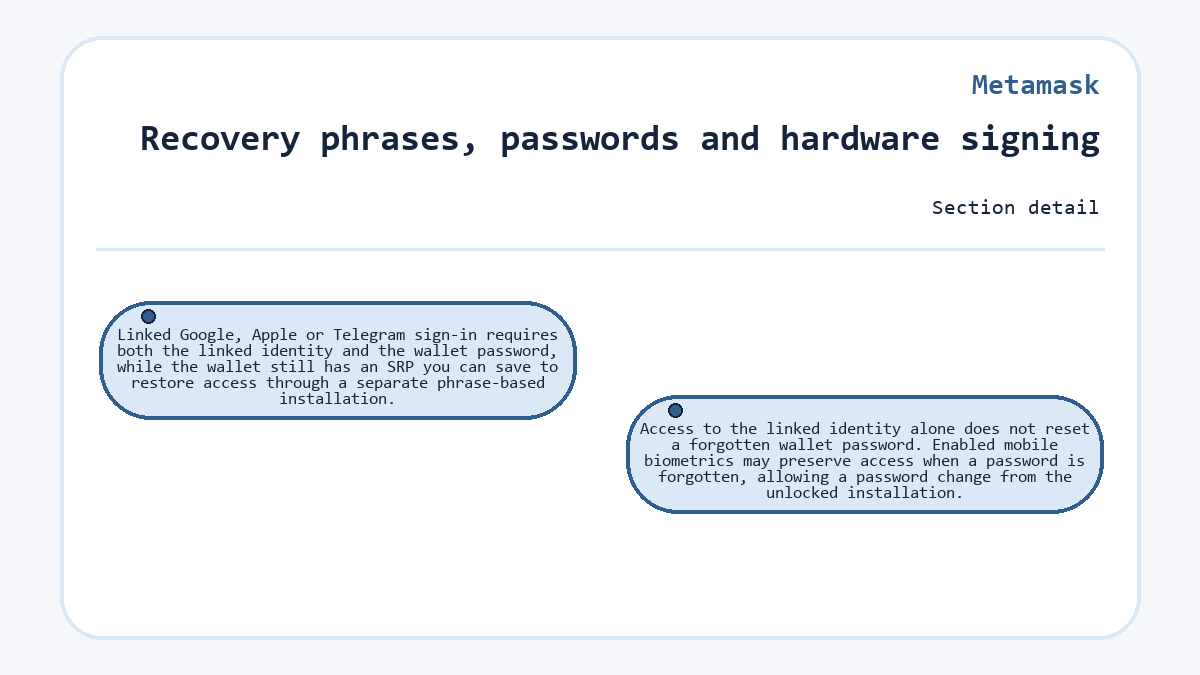
Linked Google, Apple or Telegram sign-in requires both the linked identity and the wallet password, while the wallet still has an SRP you can save to restore access through a separate phrase-based installation. Access to the linked identity alone does not reset a forgotten wallet password. Enabled mobile biometrics may preserve access when a password is forgotten, allowing a password change from the unlocked installation.
Networks and token formats determine compatibility
Ethereum, Bitcoin, Solana and Tron are supported alongside other compatible networks. Ethereum-based tokens include ERC-20 assets and non-fungible tokens (NFTs) using ERC-721 or ERC-1155. Snaps add extension capabilities through separately granted permissions. Custom network settings add compatible EVM networks using network identity and an RPC endpoint. Each network keeps its own balances, even when an EVM address is identical across chains. On EVM networks, a token's contract address distinguishes it from other tokens sharing its symbol.
Transfers, trading services and network fees
A transfer requires a destination address on the intended network, and any receiving service must support that asset. A transaction signature authorizes the request; submission and blockchain confirmation are later states. An ordinary transfer stays on its selected network. Changing the network displayed in the wallet does not bridge the asset. An Ethereum transaction can consume gas even when its contract execution fails. Gas pays for the computation the network performs, so failure does not imply a fee refund. Network demand and execution complexity affect the cost.
Swaps exchange tokens through available liquidity providers. Bridging moves value between networks, and the interface can combine both operations in a cross-network route. A quote shows expected output and applicable charges; liquidity and price changes can affect execution. A source-network confirmation alone does not establish receipt on the destination network.
Ethereum network fees are denominated in ETH. Eligible gas-included features can collect payment in another supported token and arrange the underlying fee payment. Gas-included sends, dapp transactions and gasless swaps require Smart Transactions and balance-change estimates to be enabled, while swap eligibility also depends on the network, supported token and compatible wallet version. Some networks require a smart account for eligible gasless swaps. Eligible gasless swaps through the wallet's built-in Swaps feature deduct fees from the token you swap from when native gas funds are insufficient. Gasless swaps are unavailable when the swap value is below the gas cost.
Buying and selling crypto use integrated payment providers. Available assets, payment methods and withdrawals depend on location and provider eligibility, including identity checks where required. Selling for a bank payout involves both a blockchain transfer and the provider's processing. Perpetual futures let you take long or short positions on asset prices without owning the underlying asset. They require margin as collateral and carry liquidation risk. Perps and card spending have separate regional eligibility rules.
Wallet access methods and recovery requirements
A wallet's setup determines the credentials needed to restore access. Telegram-linked setup uses the extension. Imported software accounts and connected hardware can sit beside newly created wallets, with different recovery requirements.
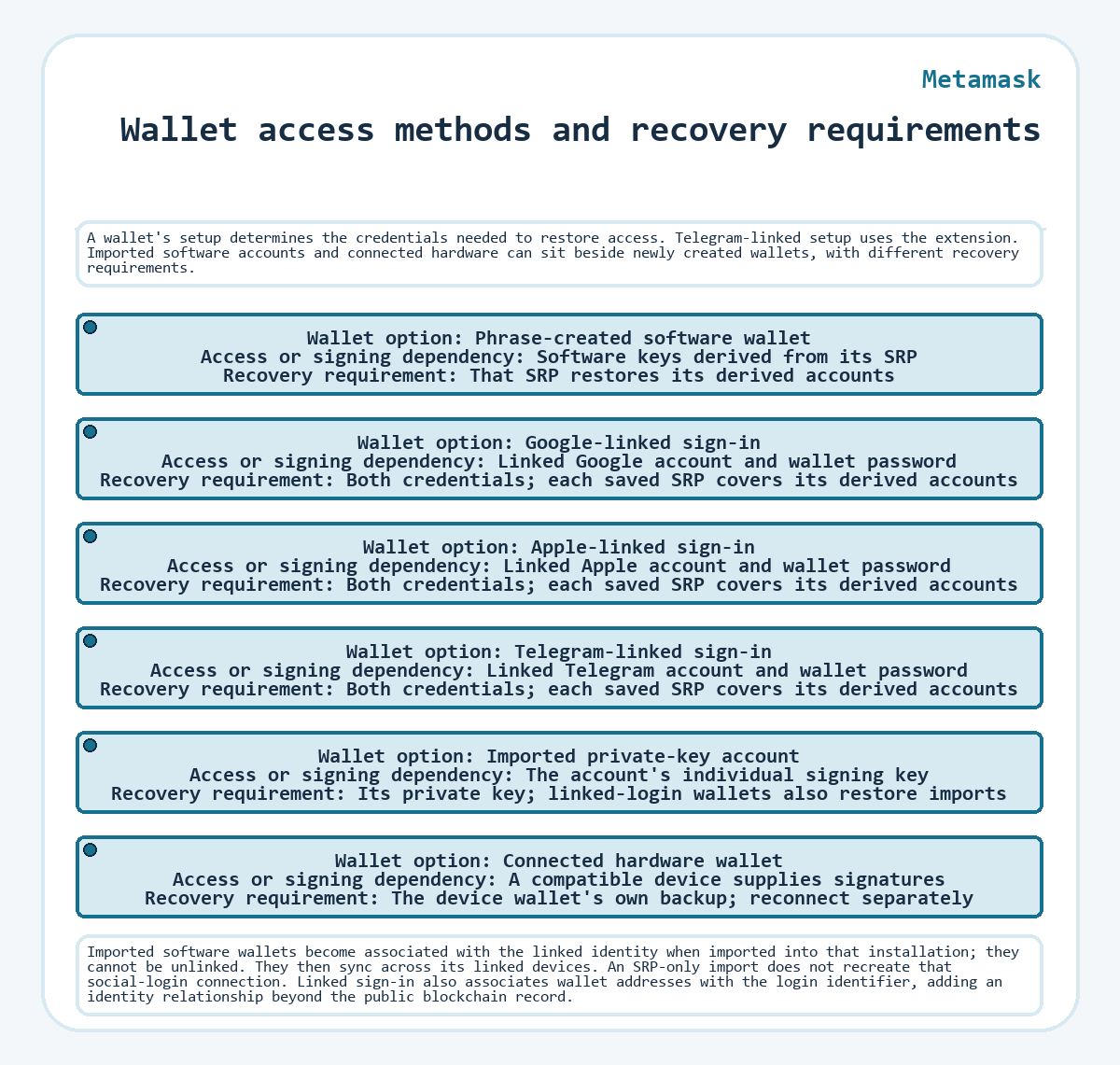
| Wallet option | Access or signing dependency | Recovery requirement |
|---|---|---|
| Phrase-created software wallet | Software keys derived from its SRP | That SRP restores its derived accounts |
| Google-linked sign-in | Linked Google account and wallet password | Both credentials; each saved SRP covers its derived accounts |
| Apple-linked sign-in | Linked Apple account and wallet password | Both credentials; each saved SRP covers its derived accounts |
| Telegram-linked sign-in | Linked Telegram account and wallet password | Both credentials; each saved SRP covers its derived accounts |
| Imported private-key account | The account's individual signing key | Its private key; linked-login wallets also restore imports |
| Connected hardware wallet | A compatible device supplies signatures | The device wallet's own backup; reconnect separately |
Imported software wallets become associated with the linked identity when imported into that installation; they cannot be unlinked. They then sync across its linked devices. An SRP-only import does not recreate that social-login connection. Linked sign-in also associates wallet addresses with the login identifier, adding an identity relationship beyond the public blockchain record.
Confirmed transfers and compromised keys
A confirmed transfer cannot be reversed by the wallet provider. Restoring a backup restores signing access to the accounts it covers; it does not rewind their history. A recipient can return assets through a new transfer, if willing and able to do so. If a deposit reaches a service through a network it does not support, recovery depends on that service's access and policies, which restoring your own wallet does not change.
An exposed recovery phrase compromises every account derived from it. Creating another account under the same phrase does not create a fresh security boundary. Changing the software password also leaves the blockchain keys unchanged. A compromised individual private key exposes the addresses and assets controlled by that key. Malware may have accessed more than one credential, so the exposure cannot be inferred from one visible unauthorized transfer.
A sweeper bot can automatically move assets from an account whose keys an attacker controls. Suspected sweeping makes further deposits, including money intended for gas, vulnerable to theft.
Transaction Shield offers a separate reimbursement route for eligible covered activity in the extension. An active subscription, a supported account and network, an eligible interaction and a Covered designation are required. Limits and claim conditions apply. Excluded losses include compromised keys, ordinary peer-to-peer transfers, speculative losses and protocol exploits outside the wallet's control. Prior activity is not covered merely because a subscription begins before its resulting loss. This protection does not repair stolen keys or undo a confirmed transaction.
What readers ask about Metamask
Do I need cryptocurrency to create a wallet?
Creating a wallet does not require an initial cryptocurrency balance or a paid subscription. The extension and mobile app are free to install. Funding becomes relevant when you want to transfer assets or use services involving blockchain transactions. The appropriate network fee must then be covered, whether through a native asset or an eligible alternative fee-payment feature.
Which browsers and phone platforms support Metamask?
The mobile app supports iOS and Android, and the extension supports Chrome, Firefox, Brave, Edge and Opera. Optional integrations have their own requirements, including compatible hardware connections and extension-only Snaps.
How can I cancel a transfer before it confirms?
Cancellation can be attempted for a supported Ethereum or EVM transaction while it is still pending. The wallet's cancellation feature submits a replacement using the same nonce, the account's transaction sequence number. A higher fee helps the replacement compete for inclusion, and cancellation can itself cost gas. The attempt can lose the race if the original confirms first; it cannot reverse an already confirmed transfer.
Where should I look when a restored wallet does not show a token?
A missing display does not establish that the tokens left the account. Compare the receiving address and network with the blockchain record. A derived account may need re-adding. An imported software account needs its own key or phrase unless restored using its linked identity and wallet password. For an EVM fungible token held at the correct address, adding its token contract address can restore the display. This changes visibility without moving the asset.
Is an unexpected token deposit proof someone controls my wallet?
An unsolicited token deposit alone does not prove that someone has your signing keys. Tokens can be sent to a public address without the recipient approving their arrival. Scam airdrops can advertise a claim, swap or reward leading to a malicious site or signature request. Following those instructions creates a separate risk. Unexpected outgoing transactions require a different investigation from an unwanted incoming token.
· last updated